

The honest answer to “is my child behind?” is usually “behind what?”. Children learn at different speeds, and a wobble in Year 2 often disappears by Year 4. But it helps to know what the national curriculum says is taught in each year, so you can tell the difference between a child who is a few weeks off the pace and one who has missed a building block everything else depends on. This guide sets out, year by year, what children are taught in English and maths from Reception to Year 6. It comes straight from the curriculum, not from us, and there’s a free one-page summary for each key stage to keep on the fridge.
Want to talk this through? The first 15-minute call is free.
Book a free call →The multiplication tables every child is taught by the end of Year 4, and tested on in the June multiplication tables check.
Before you compare: three things to know
- “Taught” is not “mastered”. The curriculum says what is covered in each year. Most children are still securing the previous year’s content while meeting the next year’s. That is normal.
- The gaps that matter are the foundations. Phonics, number bonds, times tables, reading fluency. A child can be “behind” on fronted adverbials and be absolutely fine. A child who is still guessing at words in Year 3 needs help now.
- School will tell you “expected”, “working towards” or “greater depth”. Those are judgements against the end-of-year standard. “Working towards” in one year is not a verdict; it is a flag.
Reception Age 4 to 5
Reception follows the Early Years Foundation Stage, not the national curriculum. By the end of the year, children are assessed against the Early Learning Goals. In reading and writing, children are taught to say a sound for each letter of the alphabet and at least ten digraphs, to read words by blending sounds, to read simple sentences, to write recognisable letters and to write simple phrases and sentences that can be read by others. In maths, they are taught a deep understanding of number to 10, to subitise (recognise small amounts without counting) up to 5, number bonds to 5 and some to 10, to count beyond 20, and to compare quantities.
Year 1 Age 5 to 6
English. Children apply phonics to read words, learn the sounds for all 40-plus phonemes, and read common exception words (the ones that don’t follow the rules). They say sentences aloud before writing them, join sentences with “and”, use capital letters for names and “I”, and end sentences with full stops, question marks and exclamation marks. They are taught to form lower-case letters, capitals and digits correctly.
Maths. Counting to and across 100 forwards and backwards, reading and writing numbers to 100, number bonds within 20, adding and subtracting one- and two-digit numbers to 20, recognising half and quarter as equal parts, telling the time to the hour and half past, and knowing the value of coins and notes.
Year 2 Age 6 to 7
English. Reading becomes more automatic: words of two or more syllables, common suffixes, most frequent words read without sounding out. Children write narratives, poems and accounts of real events, plan what they will write, and proofread. They use commas in lists, apostrophes for contractions and possession, the four sentence types, expanded noun phrases, past and present tense, and joining words such as “because”, “when” and “but”. Handwriting starts to join.
Maths. The 2, 5 and 10 times tables; counting in 2s, 3s and 5s; place value in two-digit numbers; addition and subtraction facts to 20 “fluently”; adding two two-digit numbers; fractions ⅓, ¼, ²⁄₄ and ¾; telling the time to five minutes; recognising £ and p and giving change.
Year 3 Age 7 to 8
English. Children use root words, prefixes and suffixes to read new words. Comprehension matters more than decoding now: inference with evidence, summarising, retrieving information from non-fiction. In writing, they organise paragraphs around a theme, create settings and characters, use headings, and begin to evaluate and edit their own work. Joined handwriting is expected in independent writing. Grammar brings a wider range of conjunctions, the present perfect (“has gone”), and punctuation for direct speech.
Maths. The 3, 4 and 8 times tables; place value in three-digit numbers; column addition and subtraction up to three digits; multiplying two-digit by one-digit numbers; counting in tenths; fractions of amounts; adding and subtracting fractions with the same denominator; telling the time to the nearest minute on 12- and 24-hour clocks; adding and subtracting money.
Year 4 Age 8 to 9
English. The Year 3 and 4 programme continues: more sophisticated inference, wider reading, dictionary use, and writing that is planned, paragraphed and edited. Fronted adverbials with commas, apostrophes with plural nouns, and expanded noun phrases are all in the Year 3 and 4 grammar list.
Maths. All multiplication tables up to 12 × 12; counting in 6s, 7s, 9s, 25s and 1,000s; negative numbers; rounding to 10, 100 and 1,000; column methods with up to four digits; formal written multiplication and short division; hundredths and decimals; converting units; perimeter and area of rectilinear shapes; 12- and 24-hour time.
Year 5 Age 9 to 10
English. Children read a broad range of texts, including myths, legends and texts from other cultures, compare characters and texts, and distinguish fact from opinion. Writing is planned for audience and purpose, with cohesion across paragraphs, and précis of longer passages. Grammar brings relative clauses, modal verbs, parenthesis with brackets, dashes or commas, and the beginnings of formal writing. Spelling covers silent letters and commonly confused words.
Maths. Numbers to at least 1,000,000; factors, multiples and primes (primes to 19 by heart); long multiplication with two-digit multipliers; short division of four-digit numbers; comparing fractions with related denominators; mixed numbers and improper fractions; thousandths; percentages and their fraction and decimal equivalents; converting metric units; perimeter of composite shapes; area in cm² and m².
Year 6 Age 10 to 11
English. The Year 5 and 6 programme continues and is tested. Children are taught passive voice, the subjunctive, semi-colons, colons and hyphens, and to use formal and informal registers. Reading comprehension is assessed on inference, retrieval, vocabulary and the author’s choices.
Maths. Numbers to 10,000,000; long division; order of operations; adding and subtracting fractions with different denominators; multiplying and dividing fractions; percentages of amounts (for example 15% of 360); ratio; simple algebra; converting miles and kilometres; area of parallelograms and triangles; volume of cubes and cuboids.
If you’re worried
- Ask the teacher one question: “Is my child working towards, at, or above the expected standard, and in which areas?” That is the information school already has.
- Look at the foundations first. Phonics in Years 1 and 2. Times tables in Years 3 and 4. Reading fluency at any age. These are the gaps that compound.
- Find out why, not just what. A child behind in maths may have a maths gap, or may have a working-memory difficulty, or may not have been able to hear the teacher. The fix is different for each.
- Don’t wait for the end of the year. Children don’t catch up by accident. A term of targeted help on the right thing usually does more than a year of general practice.
- If the gap is wide, or your child is distressed, look deeper. Our sister service Education With Lauren provides the Achieving & Thriving Gap Analysis: an independent picture of your child’s attainment, learning gaps and barriers to learning, so you know what to work on and what to ask school for.
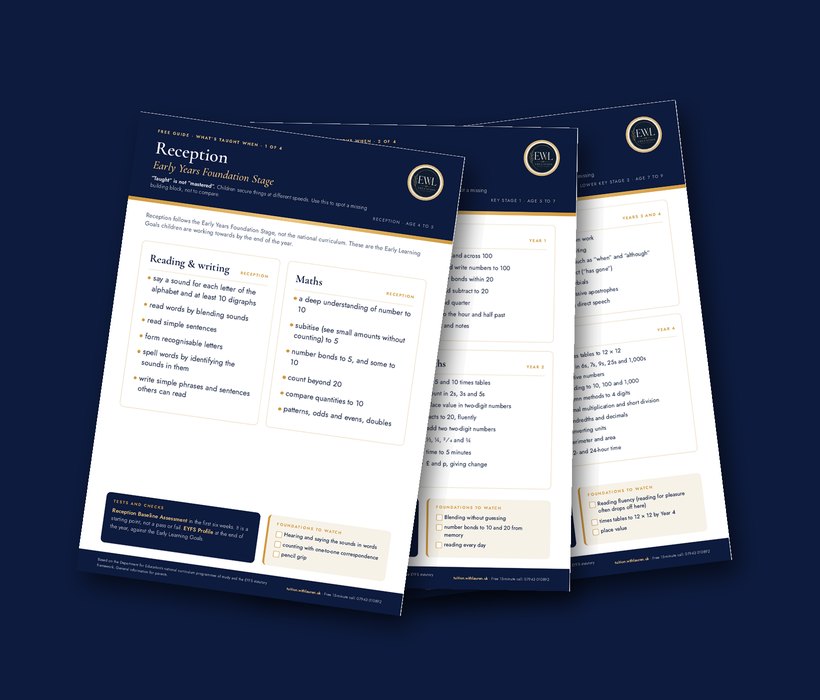
Reception to Year 6, one page per stage
Four one-page guides, one per key stage, with the English and maths content for each year from the national curriculum, the tests and checks to know about, and the foundation skills to watch.
Want a teacher to find the gaps for you? Book a free 15-minute call.
Where Tuition With Lauren fits in
- Subject Tutoring. One-to-one English and maths from Reception to GCSE. The first session finds the gaps; teaching starts from where your child actually is.
- SEND & Home Education. Specialist one-to-one teaching planned around your child’s profile and pace, for children with additional needs and for families who home educate.
- 11+ Preparation. Small-group preparation in person across Kent and East Sussex.
“…She has exceeded our expectations of what we were hoping a tutor could do. We only wish we had found her sooner!…”
“…Before starting with Lauren, Isaac hated school. Now he comes out happy and confident because he finally understands things…”
“Behind” is only useful if you know what it’s behind. Now you do.
Frequently asked questions
How do I know if my child is behind at school?
Ask the teacher whether your child is working towards, at, or above the expected standard, and in which areas. Compare what they can do with what the national curriculum says is taught in their year, and pay most attention to the foundations: phonics, number bonds, times tables and reading fluency.
What should my child know by the end of Year 1?
Year 1 children are taught to read using phonics, to write simple sentences with capital letters and full stops, to count to 100, to know number bonds within 20, and to tell the time to the hour and half past. They take the phonics screening check in June.
What times tables are taught in each year?
Year 2: 2, 5 and 10. Year 3: 3, 4 and 8. Year 4: all tables up to 12 × 12, tested in the June multiplication tables check.
What tests do primary children take?
The Reception Baseline Assessment in the first weeks of Reception, the phonics screening check in Year 1, the multiplication tables check in Year 4, and the KS2 SATs in Year 6. KS1 SATs are no longer compulsory.
My child is “working towards” the expected standard. Should I worry?
Not on its own. It means they haven’t yet secured everything taught that year. Find out which parts, and whether the gap is in a foundation skill. Targeted help on the right thing usually closes it.
Can a tutor help a child who is behind?
Yes, if the tutor starts by finding the actual gaps rather than working through a scheme. Our teachers do an initial session to identify exactly where your child is, then plan from there.
Sources
- Department for Education, National curriculum in England: English programmes of study and mathematics programmes of study
- Department for Education, Early years foundation stage statutory framework (Early Learning Goals)
- Department for Education, primary assessments: Reception Baseline Assessment, phonics screening check, multiplication tables check, Key Stage 2 tests
- This article is general information for parents. Children learn at different rates; if you’re worried, talk to your child’s teacher.
“Behind” is only useful if you know what it’s behind.
Find the gaps, then close them
Not sure where to start?
A free 15-minute call comes first.
No cost and no obligation.
- 07943 010892
- info@withlauren.uk
- Kent & East Sussex. Online sessions available UK-wide.